Round It. Estimate It. Check It.
A free interactive game that teaches children to round numbers and make sensible estimates — with Digi and his inventor friend, Pip.
Play for Free How rounding works

Why do children find rounding confusing?
Many children learn rounding as a digit rule — “look at the next digit, 5 or more rounds up” — before they know what rounding is for. Then 347 becomes 400 “because the 7 rounds up”, 368 becomes 300 “because you chop the end off”, and nobody is sure what happens to 350.
Rounding is really a question about distance: which landmark is this number closest to? Once a child can see that on a number line, the digit rule makes sense — and so do estimates.
Landmarks first, rules second
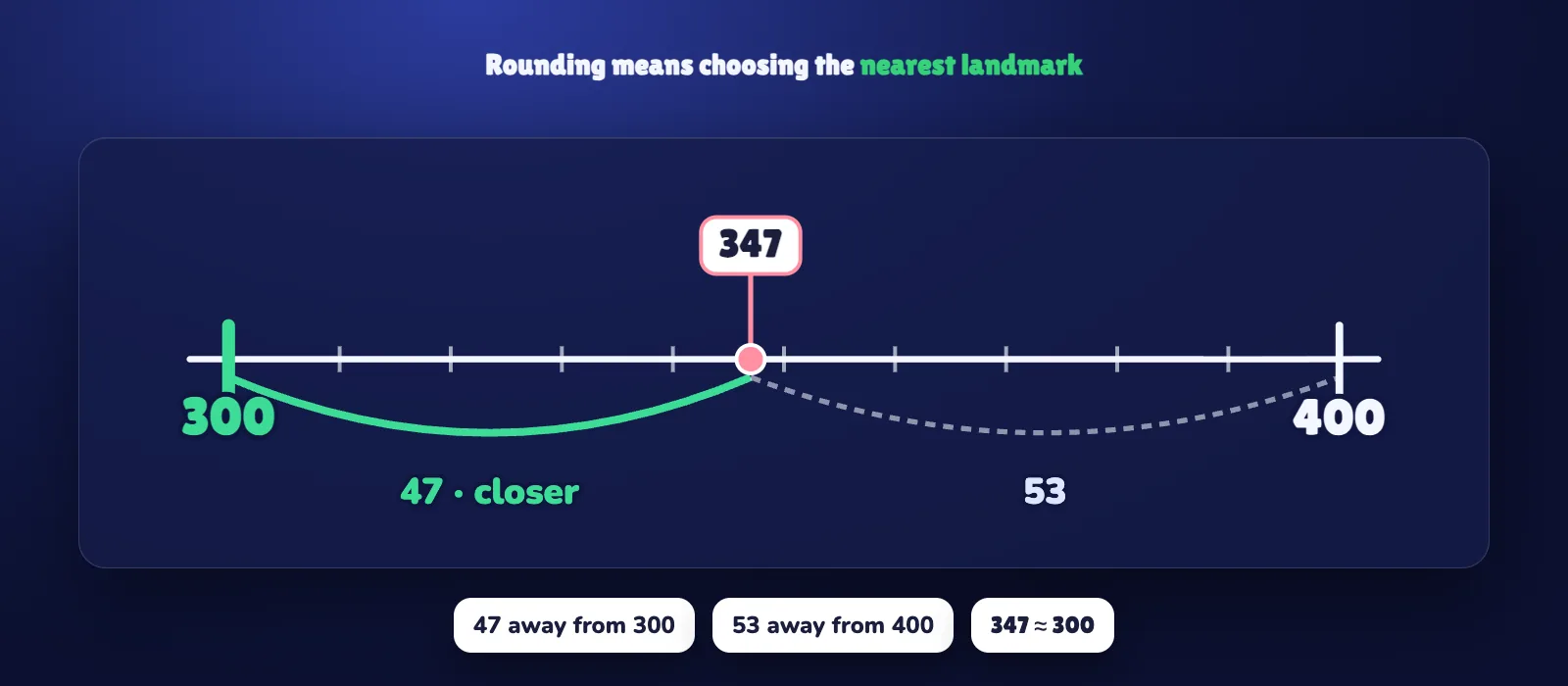
- 347 lives between 300 and 400
- it is 47 away from 300 and 53 away from 400
- so 347 rounds to 300
Find the two landmarks. Check which is closer. Exactly halfway rounds up.
Read more in how to round numbers to the nearest 10, 100 and 1,000.
The halfway rule, made clear
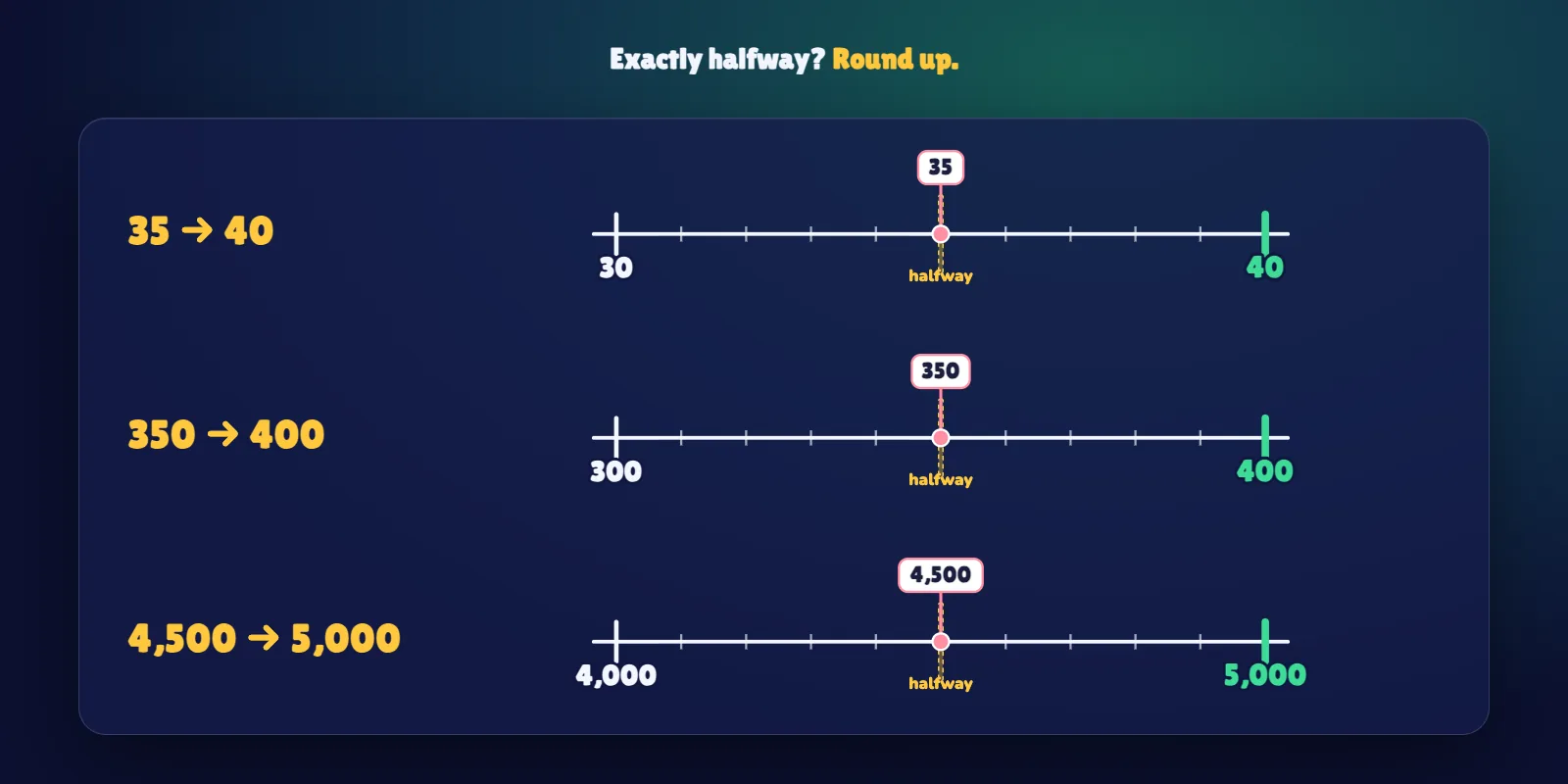
What about 35, 350 or 4,500 — numbers exactly in the middle? The game teaches one clear convention and uses it everywhere: when a number is exactly halfway between two landmarks, it rounds up. Pip’s Midpoint Detector lights up only on the exact middle, so children see the difference between “nearly halfway” and “exactly halfway”.
Digi thinks. Pip invents. Your child helps them learn.

Digi, the thoughtful robot guide from Place Value Quest and Time Quest, explains the ideas. His best friend Pip — a bouncy yellow inventor — tries everything straight away and makes exactly the mistakes real children make. Your child checks Pip’s thinking on the number line and helps fix it, so they become a co-teacher, not just a student.
Tens Bubble-Blower
Numbers float to their nearest ten — 32 to 30, 36 to 40.
Hundreds Spring Launcher
347 springs to 300, 372 to 400, and 650 up to 700.
Thousand-Hop Boots
The same idea at a bigger scale: 2,780 hops to 3,000.
Estimate-O-Meter
Too low, too high or sensible? Real-life numbers from crowds to prices.
Calculation Checker
Estimate first, then compare with the exact answer.
Mistake Scanner
Catch a rounding slip — then explain why it’s wrong.
Estimate first, then check
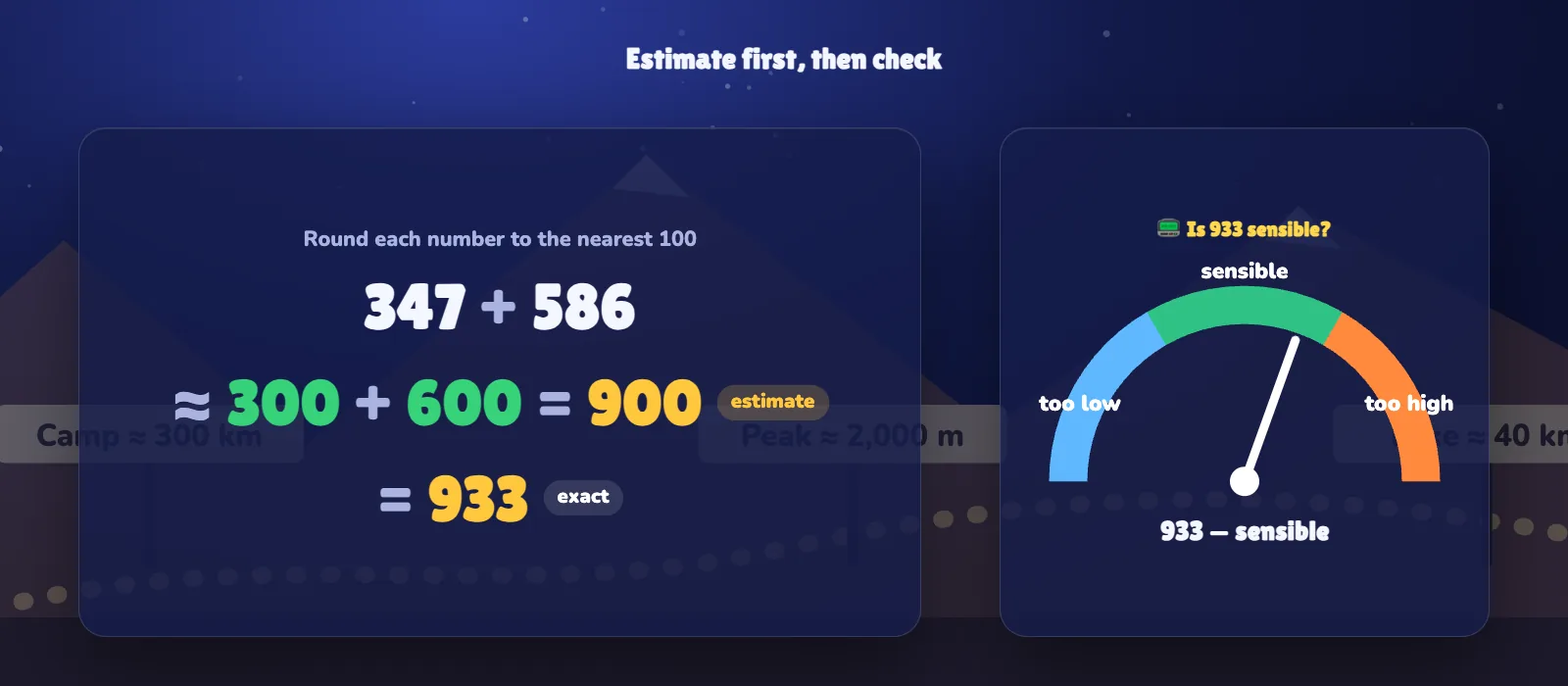
Estimating isn’t a guess. Round each number to a convenient landmark, then calculate in your head: 347 + 586 is about 300 + 600 = 900. The exact answer, 933, is close — so it’s sensible. If an answer is far away from the estimate, it’s worth checking again. This is the habit that helps children check written calculations at school, including four-digit subtraction with exchanging.
Read more in how to estimate answers to check calculations.
Three worlds, ten lessons
- Rounding Valley — The number line, the Tens Bubble-Blower and the Midpoint Mystery
- Estimation City — Nearest 100, nearest 1,000 and sensible estimates
- The Estimation Expedition — Real-life estimating, estimate first, Detective Digi and the Great Estimation Quest
Every lesson finishes with a Digi Check and unlocks a matching outfit for Digi and Pip — astronauts, pirates, wizards and more.
Free to play
Free, with no subscription, no signup and no ads. Open the page and play — progress is saved on your device, separately from the other Digi games. Grown-ups can see skills, common mix-ups and suggested practice in the parent area.
Part of the Digi family
Estimation Quest builds on place value: knowing what each digit is worth makes rounding to 10, 100 and 1,000 much easier.