How to Estimate an Answer
Last updated:
To estimate an answer, round each number to a convenient landmark and calculate with the rounded numbers. 347 + 586 is about 300 + 600 = 900. The exact answer, 933, is close to the estimate, so it is sensible. An estimate is not meant to match exactly — it tells you roughly where the answer should be.
What an estimate is (and isn’t)
An estimate is a quick, reasoned “about” answer. It is not a wild guess, and it is not meant to equal the exact answer. A good estimate uses rounding so the sum can be done in your head.
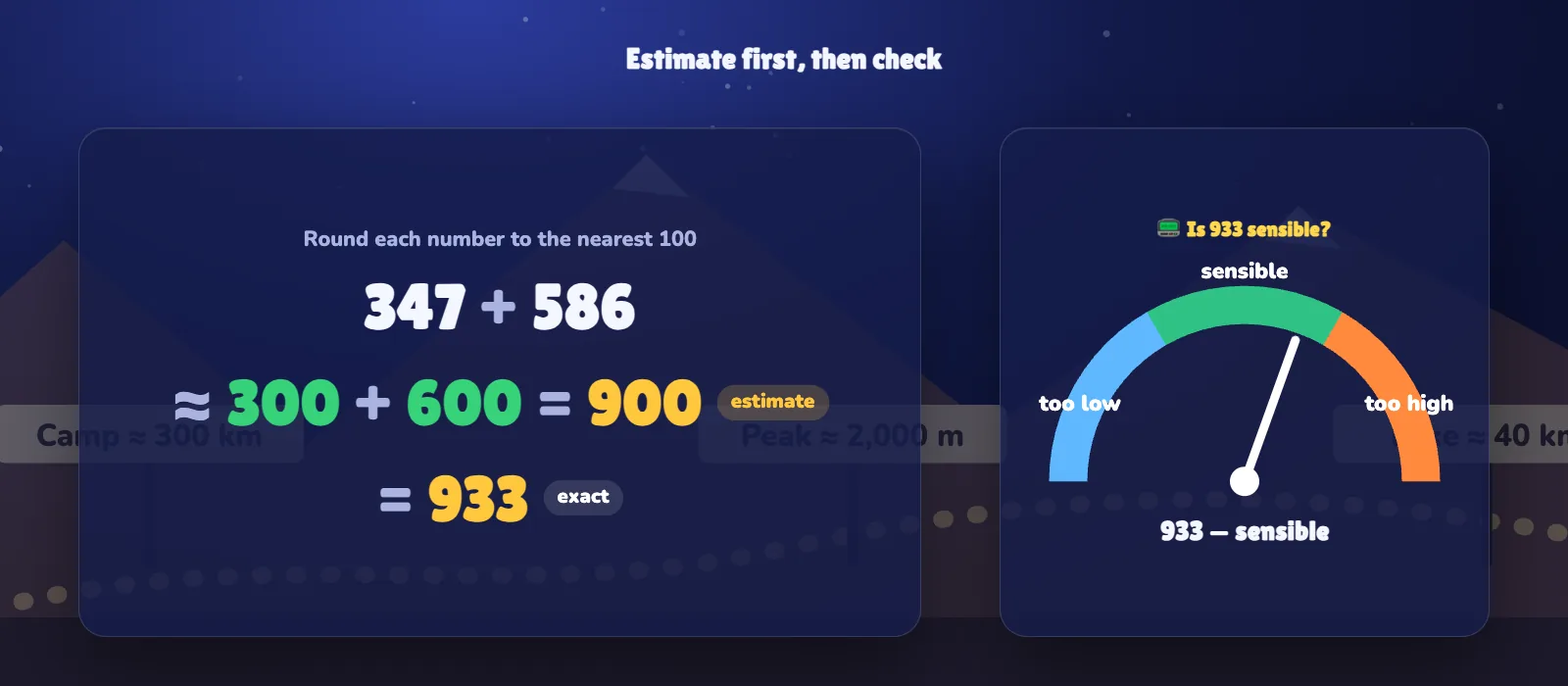
Estimate first, then check
- Round each number. 7,865 − 4,278: to the nearest 1,000, that is 8,000 − 4,000.
- Calculate the estimate. 8,000 − 4,000 = 4,000.
- Work out the exact answer. 7,865 − 4,278 = 3,587.
- Compare. 3,587 is reasonably close to 4,000, so it is sensible. If you had written 1,587 or 5,587, the estimate would tell you to check again.
Choosing a sensible estimate
Real-life numbers are rounded all the time: 487 pupils is “about 500”, 4,782 spectators is “about 5,000”, a 287 km journey is “about 300 km”. A sensible estimate is rounded to the landmark that the situation (or the question) asks for, and it is described as “about”, never “exactly”.
Try at home
- Shopping estimate. Before paying, round each price to the nearest pound and add. How close was the receipt?
- Homework check. Before checking a subtraction, ask “roughly what should it be?”
- Who is right? Give two estimates for the same number and ask your child which is more sensible — and why.
Practise with Digi and Pip in Estimation Quest →
Start with the basics: how to round numbers.