How to Round Numbers
Last updated:
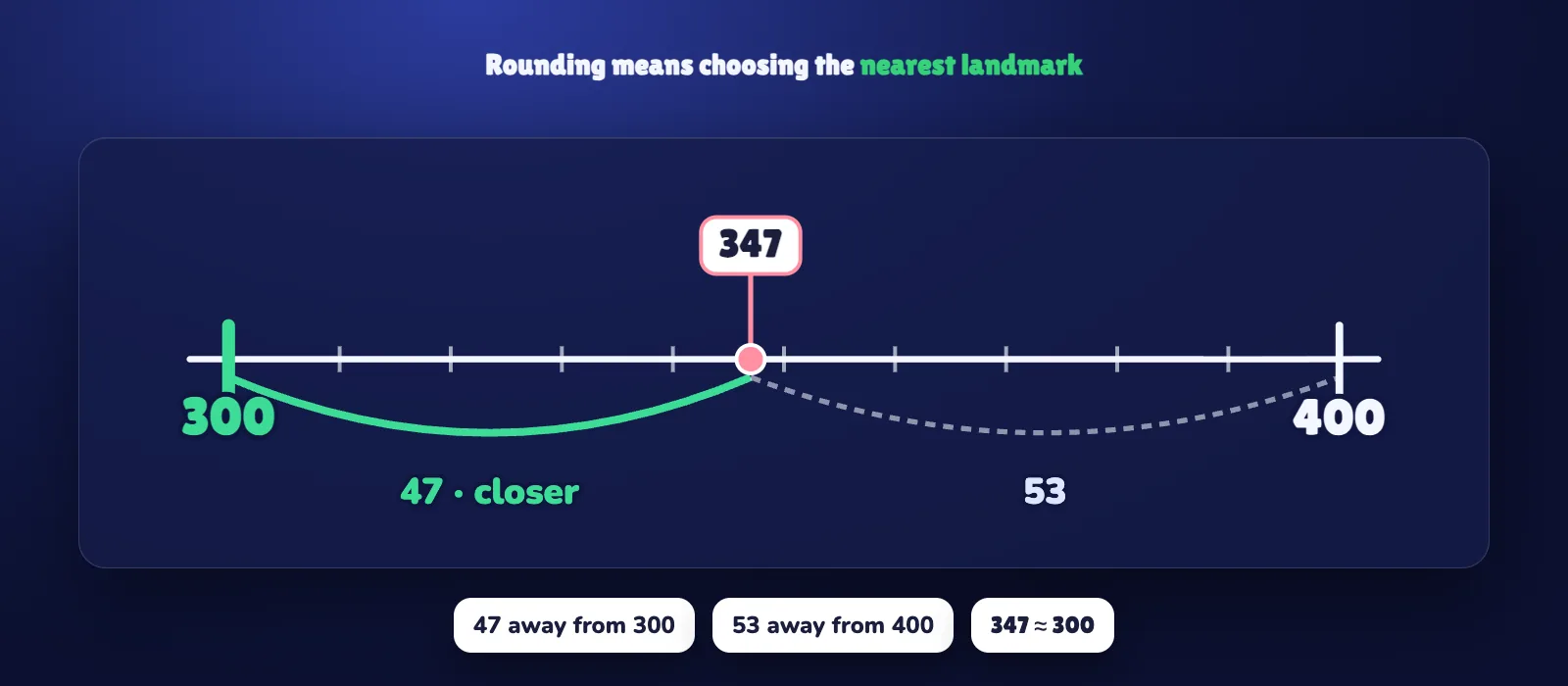
To round a number, find the two landmarks either side of it — the tens, hundreds or thousands the question asks for — and choose the one it is closer to. 347 is between 300 and 400; it is 47 away from 300 and 53 away from 400, so 347 rounds to 300 (to the nearest 100). If a number is exactly halfway, like 350, it rounds up.
Rounding means choosing the nearest landmark
A landmark is a “friendly” number that is easy to work with: a multiple of 10, 100 or 1,000. Rounding replaces a number with the landmark it is closest to. We do it all the time — “about 500 pupils”, “roughly 300 km” — because rounded numbers are quicker to say, compare and calculate with.
Step by step
- Read the question. Does it ask for the nearest 10, the nearest 100 or the nearest 1,000?
- Find the two landmarks. 347 to the nearest 100: count in hundreds — 300, 400. So 347 is between 300 and 400.
- Compare the distances. 347 is 47 away from 300 and 53 away from 400.
- Choose the closer landmark. 300 is closer, so 347 ≈ 300.
Examples at three scales
| Number | Nearest 10 | Nearest 100 | Nearest 1,000 |
|---|---|---|---|
| 347 | 350 | 300 | 0 (it is closer to 0 than to 1,000) |
| 2,240 | 2,240 | 2,200 | 2,000 |
| 2,780 | 2,780 | 2,800 | 3,000 |
| 9,750 | 9,750 | 9,800 | 10,000 |
Notice that 9,750 rounds to 10,000 — the answer can gain a digit.
The halfway rule
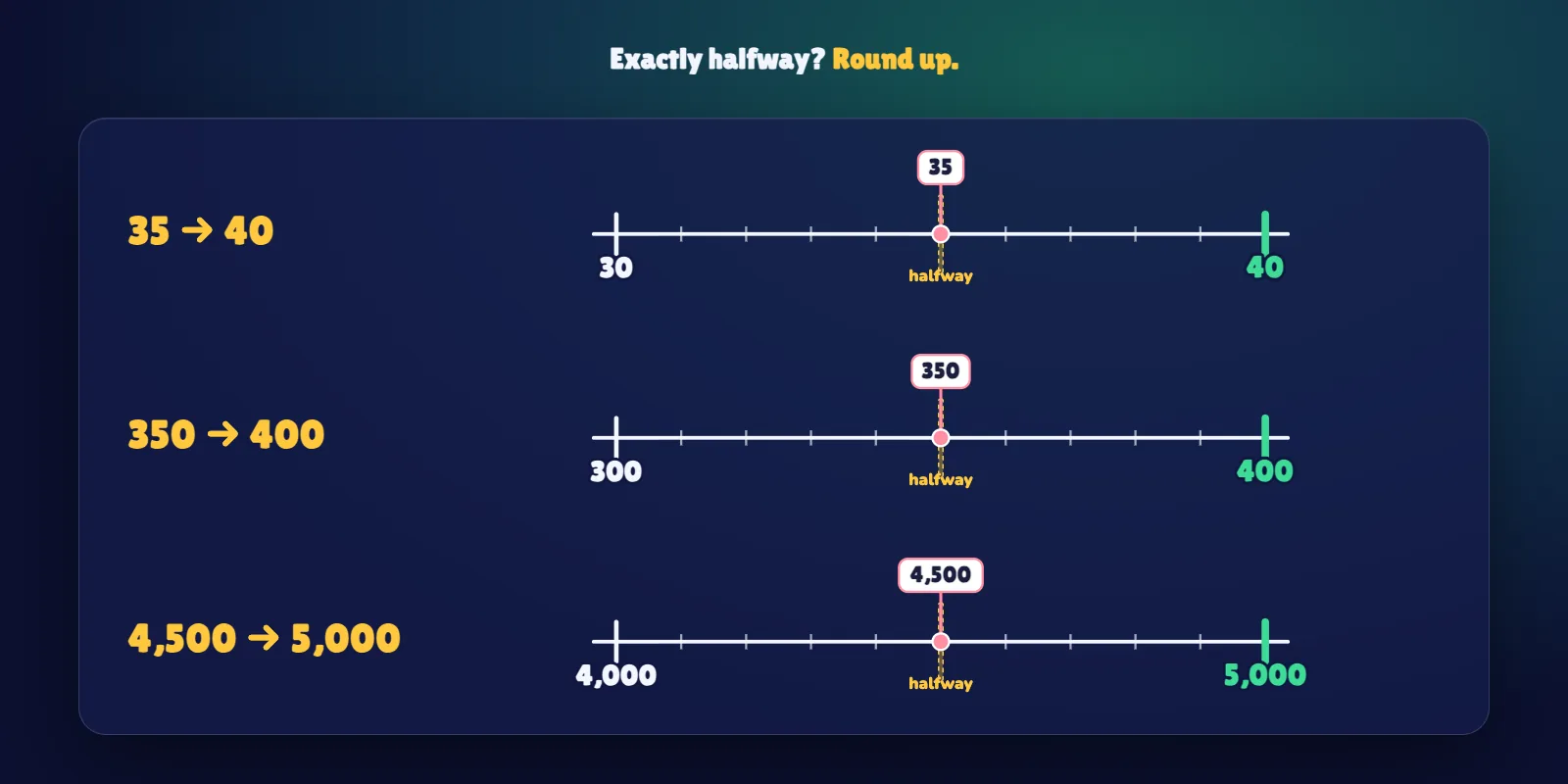
When a number is exactly halfway between two landmarks, it is the same distance from both, so we need a rule. The usual convention — and the one Digi’s Estimation Quest uses — is to round up: 35 → 40, 650 → 700, 4,500 → 5,000. Only the exact middle counts: 349 is below halfway and rounds to 300; 351 is above halfway and rounds to 400.
The digit shortcut — after the idea
Once the number-line idea makes sense, there is a quick check: look at the digit just to the right of the place you are rounding to. For the nearest 100, that is the tens digit. 5 or more rounds up; 4 or less rounds down. The common slip is looking at the wrong digit — “347 → 400 because the 7 rounds up” — when it is the tens digit, 4, that decides.
Try at home
- Number line on paper. Draw a line from 300 to 400, mark 347 and ask which end it is nearer.
- House numbers and prices. Round them to the nearest 10 or 100 on a walk or at the shops.
- Halfway hunt. Ask: which number is exactly halfway between 60 and 70? Between 2,000 and 3,000?